

 18:25
|
18:25
|
 २३:१०
२३:१० Gen Z revolt forced political recalibration in Nepal, scholars say


London — Nepal’s recent Gen Z–led civic uprising has forced mainstream political parties to recalibrate their internal structures and incentive systems, while also reigniting debates on the role of the army, democratic accountability, and Nepal’s strategic positioning between India and China, leading scholars have said.
Addressing a virtual webinar entitled ‘Contemporary Political Development in Nepal: What Lies Ahead’, organised by the Centre for Nepal Studies UK (CNS UK) on Saturday, Emeritus Professor at the University of New Mexico, Dr Alok Bohara, argued that Nepal’s Gen Z movement—though unorganised and leaderless—acted as a powerful self-organising swarm of diverse, digitally savvy civic nodes within a democratic system that had failed to reform itself.
“I wrote back in May 2023 that Nepal was on the verge of collapse,” Prof Bohara said. “When political systems fail to recalibrate or self-correct, democracy itself opens up space for “corrective forces”—not necessarily to change leaders, but to change incentives.”
Leaderless revolt, systemic shock
According to Prof Bohara, the Gen Z movement did not dictate specific political outcomes but created a political shock that compelled institutions to respond. The dissolution of Parliament and subsequent internal realignments—particularly within the Nepali Congress (NC)—were direct consequences of this civic pressure.
“In the Nepali Congress, recalibration happened under the leadership of Gagan Thapa,” he said. “The movement was not about replacing individuals but about addressing prolonged inaction. When a shock occurs, the system has to respond.”
He noted that institutional ambiguity within parties—particularly leadership rivalries between factions loyal to former Prime Minister Sher Bahadur Deuba, Dr Shekhar Koirala, and reformist leaders—became more visible after the movement.
“Many leaders sat on the fence. But once the Election Commission delivered its verdict within 48 hours, everything changed. People realigned, formed coalitions, and moved forward,” he said, adding that this demonstrated how not only institutions, but also individual political actors, responded to the shock triggered by the Gen Z uprising.
Why some parties reformed—and others did not
Prof Bohara contrasted the NC’s reform trajectory with that of other parties, arguing that organisational culture played a decisive role.
“Parties that are less regimented and more internally contested can reform,” he said. “The UML is a tightly controlled organisation. That makes adaptation difficult.”
He stressed that democratic parties must allow internal debate, periodic feedback, leadership renewal, and democratic candidate selection.
“In Nepal, parties are often run like private clubs. The Election Commission never seriously enforced constitutional provisions on internal party democracy. Ironically, it took a Gen Z revolt to force reforms that civil society itself had failed to demand,” he said.
According to Prof Bohara, long-standing political “collusion” among top leaders—Sher Bahadur Deuba, KP Sharma Oli, and Pushpa Kamal Dahal—had hollowed out accountability mechanisms and weakened democratic norms.
What lies ahead for Gen Z
Prof Bohara cautioned against institutionalising the Gen Z movement as a political party.
“Gen Z is not a party and should not be a party,” he said. “The existence of around 30 Gen Z organisations is a strength. Their flat, organic, self-organising model gives them flexibility.”
He suggested that Gen Z should evolve into a strong, independent civic pressure group focused on a limited number of core agendas such as good governance and accountability.
“Nepal desperately needs an independent pressure group. Civil society played that watchdog role in the 1990s,” he said.
He added that initiatives such as parliamentary accountability watchdogs and anti-corruption public dashboards could serve as rallying niches for Gen Z civic groups.
“A young Gen Z group has already taken the initiative to develop a portal archiving Nepal’s major corruption scandals (for example, Jawafdehi). This kind of sustained pressure is essential,” Dr Bohara said.
Army as a stabilising force
Addressing concerns over civil-military relations, Prof Bohara described the Nepal Army as a crucial stabilising force during periods of crisis.
“When there is chaos and a vacuum, it doesn’t remain a vacuum for long,” he said, referring to geopolitical pressures from large powers to the north and south. “The army helped prevent a rapid collapse. That role deserves acknowledgement. The role of the President was also commendable in preventing forces that were attempting to derail the democratic track.”
However, he emphasised that military stabilisation must remain transitional and supportive of democratic processes.
Manifestos, governance and accountability
Prof Bohara criticised Nepal’s political culture of lengthy, symbolic manifestos devoid of implementation plans.
“I call it the ritual of manifestos,” he said. “People are asking very good questions, but political parties are not being compelled to answer them.”
Drawing parallels with US President Franklin D. Roosevelt’s first 100 days, he argued for a sharper focus on a few transformative priorities.
“It’s not about 30-page documents or 100 promises. It’s about picking and prioritising a few—and then doing them well,” he said.
He cited higher education reform and the revitalisation of the roughly 25 percent of Nepal’s land that remains barren as areas where parties must articulate concrete implementation strategies—something he said civil society and media have failed to demand.
Prof Bohara strongly rejected what he called a “paranoid” approach to foreign policy.
“Nepal’s location between India and China is an asset, not a liability,” he said.
He proposed a China–India–Nepal summit in Kathmandu to reposition Nepal as a corridor of innovation, technology, and connectivity through a Trans-Himalayan network.
“Nepal can turn geopolitics in its favour if we have visionary leadership,” he said.
Election outlook and risks of shallow debate
Also speaking at the event, Dr Uddhab Pyakurel, Dean of the School of Arts at Kathmandu University, said Nepal had so far avoided election-related violence despite dire warnings, with all major parties preparing for elections scheduled for 5 March 2026.
He identified former Kathmandu Mayor Balendra Shah (Balen) as a determining factor in the upcoming polls, noting that mainstream parties face high stakes. “It’s too early to project outcomes,” he said. “There are three established political forces, and Balen adds a new layer of competition.”
Dr Pyakurel said the NC’s internal democratisation had made it more popular among Gen Z, despite reforms coming late. However, he expressed disappointment at the post-movement political discourse.
“The debate on the ground is new versus old, not about agenda,” he said. “That is deeply worrying.”
He warned that if politics remained trapped in generational binaries, the movement risked being hijacked by actors lacking vision or mission. “Nepal’s constitution is radical, especially in empowering local governments, which are actually performing well. Yet former ministers and MPs recycle vague promises.”
Call for deeper democratic debate
Dr Pyakurel stressed the need for sustained public debate through media, academia and digital platforms. “Today, everyone has the tools to question candidates directly,” he said. “This opportunity exists because of social media and technological change. Debate promotes democratisation.”
He also urged Nepalis to focus inward rather than blaming neighbours. “Both India and China eventually accepted Nepal’s federalisation. Our real concern should be what is happening inside the country.”
On electoral integrity, he said courts were unlikely to intervene in the election process, citing precedents from past democratic movements.
He concluded by calling for stricter standards for election manifestos. “Manifestos should be like PhD proposals—clear, methodical and debated publicly.”
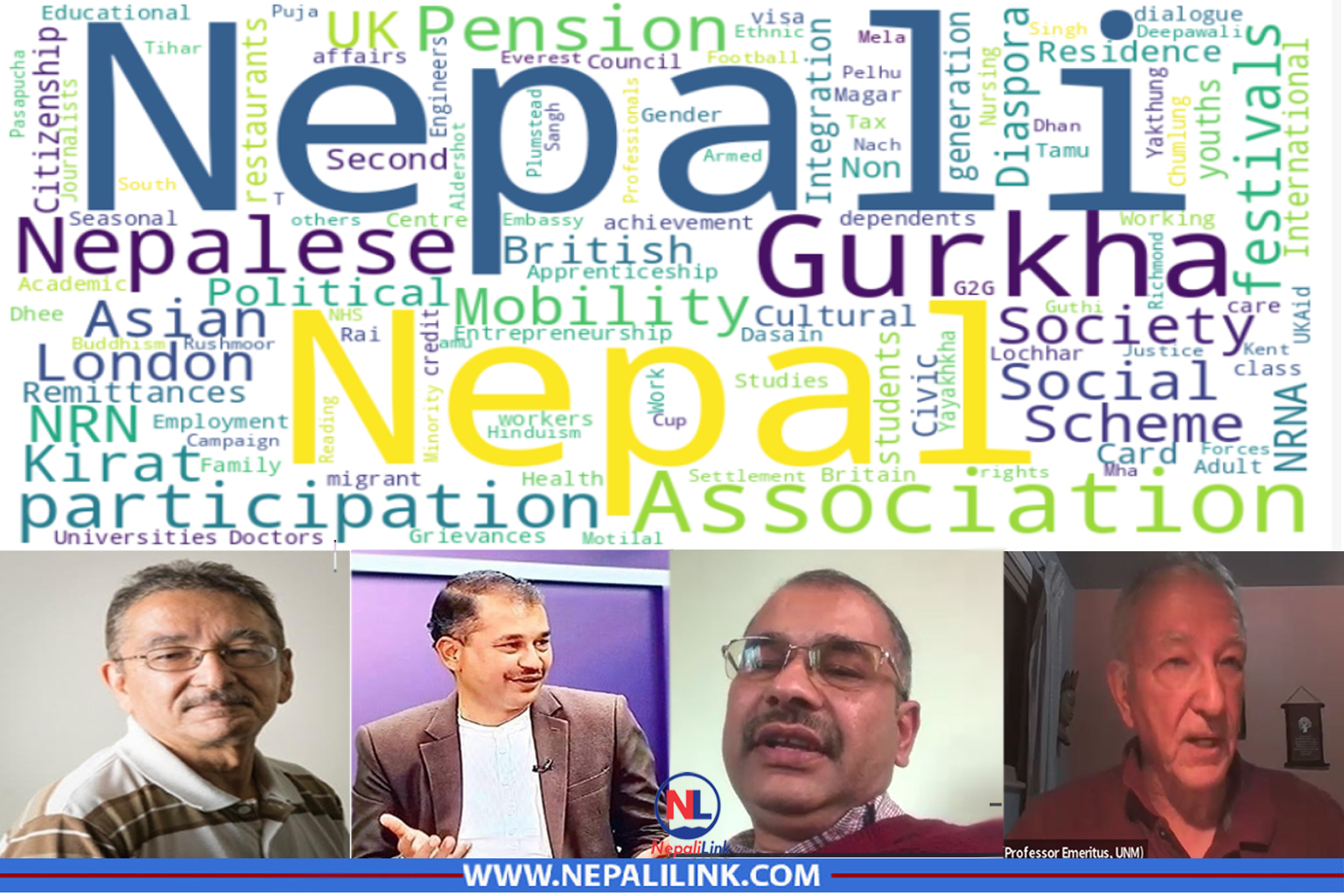
Dr Sushma Basnet, member of the CNSUK welcomed all the participants. Chair of CNS UK’s Nepal Dialogue Webinar Series, Dr Krishna Adhikari, introduced the speakers and welcomed all the participants, and moderated the panel discussion. CNS UK, a think-tank established in 2007, has been organising monthly webinars on issues related to Nepal and the UK, on the first Saturday of every month since 2025.



सम्बन्धित सामग्रीहरू


हाम्रो सिफारिस

- १
- २
- ३
- ४
- ५