

 18:01
|
18:01
|
 २२:४६
२२:४६ A Strategic Turnaround for Nepal Airlines: Lessons from the PIA Privatisation Model


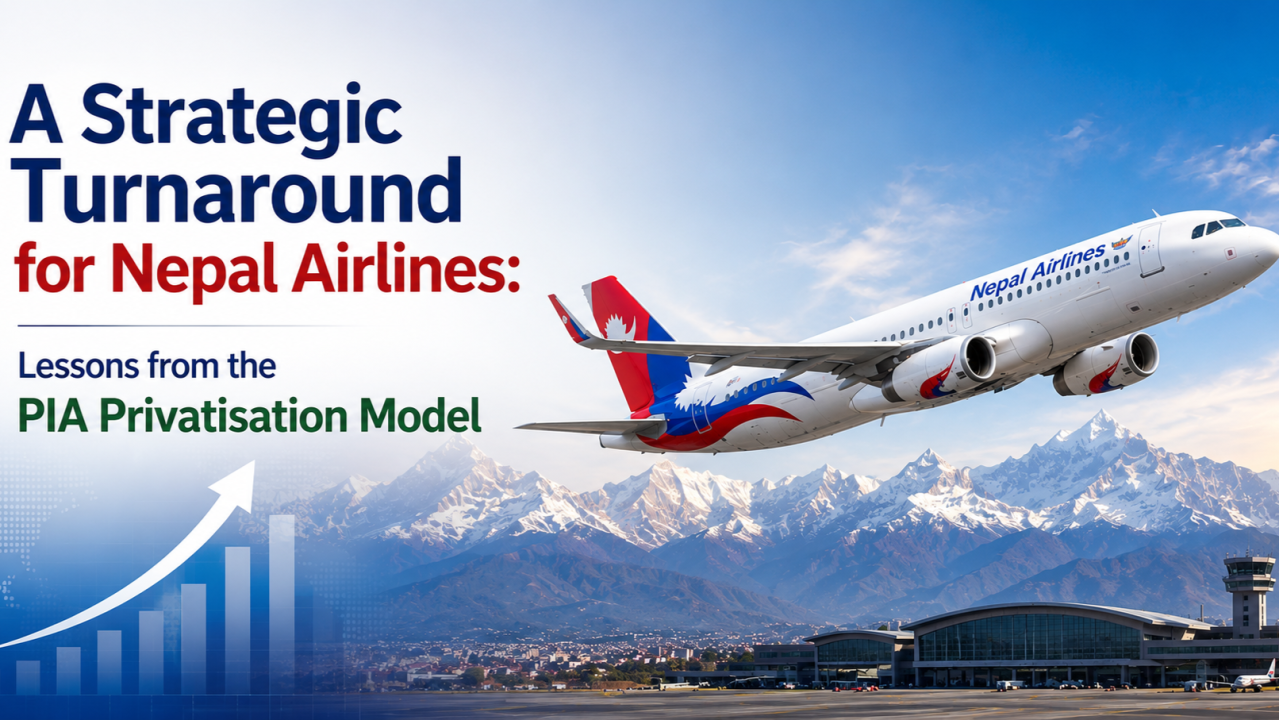
By Anand R Acharya
Nepal Airlines Corporation (NAC) stands at a crossroads that will determine whether it survives as a viable carrier or fades into the growing list of failed state-owned airlines. With debts exceeding assets and chronic mismanagement threatening its existence, the airline desperately needs a lifeline. Surprisingly, that lifeline may come from an unexpected source: Pakistan International Airlines’ recent privatization success.
The Crisis at Nepal Airlines: A Carrier in Distress
Nepal Airlines Corporation, the nation’s wholly government-owned flag carrier, presents a troubling financial picture as of late 2025. The airline’s outstanding principal loans stand at Rs34.83 billion, but when capitalized interest and penalties are factored in, total liabilities balloon to approximately Rs50 billion. More alarmingly, the airline’s debt-to-assets ratio has climbed to 1.09, meaning liabilities now exceed total assets—a clear marker of insolvency risk.
The stakes extend beyond the airline itself. Public savings invested through institutions like the Employees Provident Fund and Citizen Investment Trust (CIT), are now at risk, making NAC’s financial health a matter of public concern rather than merely a corporate challenge.
Yet amid this financial turbulence, there are encouraging operational signals. During the first four months of fiscal year 2025/26 (mid-July to mid-November 2025), NAC earned nearly Rs6 billion, primarily from international routes that carried 218,333 passengers. This translates to approximately Rs26,000 in revenue per international passenger—a respectable figure that suggests the airline’s core product remains viable when properly managed.
The domestic operations tell a different story, contributing a mere Rs35 million from 5,678 passengers during the same period. However, NAC’s domestic network serves a critical social function, connecting remote and hilly regions with limited alternatives, particularly through its DHC-6 Twin Otter STOL (Short Take-off and Landing) aircraft.
The Irony of Nepal’s Tourism Boom
Nepal’s tourism sector, which should be NAC’s greatest asset, recorded 1,158,459 international arrivals in 2025. This represents a remarkable 97% recovery to pre-COVID 2019 levels, demonstrating the enduring appeal of the Himalayas, cultural heritage sites, and adventure tourism. India alone sent 292,438 visitors, making it the largest source market.
The cruel irony is that NAC captures only a fraction of this traffic at Tribhuvan International Airport in Kathmandu, where foreign carriers—including Indian, Middle Eastern, Chinese, and Southeast Asian airlines—dominate the market. The flag carrier that should be Nepal’s primary beneficiary of tourism growth instead watches from the sidelines as competitors reap the rewards.
A History of Failed Reforms
The problems at NAC aren’t new, nor are attempts to fix them. Multiple government evaluation teams have proposed reforms over the years, including public-private partnerships, management contracts, and, most recently in November 2025, a recommendation to split NAC into three separate entities handling international operations, domestic services, and ancillary businesses.
What unites all these proposals is their lack of implementation. Political interference, bureaucratic inertia, and resistance from various stakeholders have consistently derailed reform efforts. The result is an airline that continues to deteriorate while opportunities slip away.
PIA Bold Move: The Privatization Blueprint for RA
In December 2025, Pakistan International Airlines completed what many observers considered impossible: a successful privatization that attracted serious investment while protecting the airline’s operational future.
The transaction saw a 75% controlling stake sold to an Arif Habib-led consortium for Rs135 billion (approximately $482 million), marking Pakistan’s largest privatization in nearly two decades. Crucially, this wasn’t merely a fire sale driven by fiscal desperation, though the International Monetary Fund had basically given Pakistan an ultimatum: privatize PIA or no $7 billion loan.
The IMF was tired of watching Pakistani taxpayer money disappear into airline bailouts year after year—it was undermining the entire economy. But here’s the interesting part: this IMF pressure actually made bidders more confident, not less. How? Because investors knew this time the government couldn’t chicken out. Past privatization attempts had failed when politicians got cold feet. But with the IMF making it mandatory, bidders knew the deal would actually happen. It removed the biggest risk: political interference killing the sale at the last minute.

What Made PIA’s Privatization Work?
The genius of PIA’s privatization lay in its structure, which addressed the fundamental challenges that make distressed airline sales difficult:
Comprehensive Debt Restructuring: PIA’s legacy liabilities were staggering—estimates ranged from Rs650 billion to Rs950 billion, including Rs690-900 billion in debts, pension obligations, and accumulated losses. Rather than force buyers to assume this crushing burden, the government transferred these legacy liabilities to a holding company (PIAHCL) that would remain state-owned. The entity being sold retained only manageable liabilities of approximately Rs 202 billion, payable over time, creating a cleaner balance sheet with positive net equity ranging from Rs 3.5 to 9 billion post-restructuring.
This approach mirrors the successful Air India privatization, where the Indian government absorbed approximately 75% of the carrier’s debt to make the acquisition viable for the Tata Group.
The Reinvestment Mandate: Perhaps the most innovative element was the bid structure requiring 92.5% of proceeds (approximately Rs125 billion) to be reinvested directly into PIA for fleet expansion, route development, and service upgrades. Only 7.5% (around Rs 10 billion) would go to the government exchequer as cash.
This transformed the transaction from a government revenue exercise into a genuine recapitalization of the airline. The winning consortium committed to expanding PIA’s fleet from 18 aircraft to 38-40 within four years, with a long-term target of 65 aircraft. This reinvestment requirement ensured that buyers weren’t simply acquiring assets to strip but were committed to building a viable airline.
Protecting Stakeholders: The structure included important safeguards: the government retained a 25% stake initially (with the buyer holding an option to acquire it at a 12-15% premium), employees were protected from layoffs for one year, and the PIA brand would be retained. These provisions addressed concerns about asset-stripping and mass unemployment that often derail privatizations in developing countries.
Process Transparency: Following prequalification requirements, the sale proceeded through a transparent auction process. The winning bid exceeded PIA’s book value significantly, driven by intangible assets like airport slots, route rights, and growth potential in Pakistan’s recovering aviation market.
Post-Privatization Outlook
The transaction effectively ended the cycle of taxpayer-funded bailouts that had cost Pakistan approximately $1.7 billion in losses between 2015 and 2024. More importantly, it provided PIA with the capital injection needed for a genuine turnaround, de-risking the asset while attracting local investors despite ongoing controversies surrounding the airline.
Nepal Airlines Today: Hidden Value Amid the Challenges
To understand NAC’s privatization potential, we must look beyond the debt figures to assess its operational reality and strategic assets.
Fleet and Network
As of December 2025, NAC operates a modest but strategically composed fleet. Two Airbus A330-200 wide-body aircraft handle long-haul international routes, while two A320 narrow-body aircraft serve regional and shorter international destinations. The two DHC-6 Twin Otter fleet provides essential STOL services to remote domestic airports nestled in Nepal’s challenging terrain.
The international network has expanded recently, now covering 11 destinations, including major Indian cities (Delhi, Mumbai, Bengaluru), Gulf hubs (Doha, Dubai), Southeast Asian points (Bangkok, Kuala Lumpur), and East Asian destinations (Hong Kong, Narita, and Guangzhou – launched in September 2025). Domestically, NAC serves approximately 18 points, emphasizing routes to remote and hilly regions where road access is difficult or impossible.
A positive recent development was the payoff of an $8.4 million (Rs1.26 billion using the exchange rate of Rs150) aircraft loan in October 2025—roughly equivalent to what the airline earns from international operations in a week. This demonstrates some capacity for debt servicing despite broader financial challenges.
The Asset Value Equation
NAC’s challenges mirror those of pre-privatization PIA: overstaffing, an EU airspace ban in place since 2013 due to safety concerns, fleet inefficiencies, and chronic political appointments that undermine professional management. These are serious problems, but they’re also fixable with proper investment and management.
More importantly, NAC possesses strategic assets that hold genuine value:
Bilateral Rights: NAC holds irreplaceable bilateral traffic rights to key markets including India (the largest source of tourists), China (an emerging market with Belt and Road connections), and Gulf countries (serving Nepal’s substantial labour migration flows). These rights cannot be easily replicated by new entrants.
Hub and Slot Advantages: Priority access at the increasingly congested Tribhuvan International Airport provides NAC with a structural advantage. As Kathmandu grows as a gateway to the Himalayas, these slots will only increase in value.
Tourism Monopolies: On certain remote domestic routes, particularly those serving trekking regions and Everest tourism, NAC faces virtually no competition due to infrastructure and aircraft requirements. These routes feed premium tourism segments with a high willingness to pay.
Network Underutilization: Many of NAC’s routes operate with frequencies far below market potential, offering immediate opportunities for yield growth with additional aircraft.
A Tailored Approach: Adapting the PIA Model for NAC
Given NAC’s smaller scale, roughly one-tenth of PIA’s pre-sale valuation, and Nepal’s distinct context without IMF-driven mandates, a scaled-down but structurally similar model could succeed.
Phase 1: Financial De-Risking Through Debt Restructuring
Following the PIA precedent, the Nepali government should transfer NAC’s legacy debt of Rs45-50 billion, including long-term loan obligations and pending litigation, to a specially created government vehicle or holding company. This would absorb the historical burden while allowing the operating airline to start with a clean slate.
The entity prepared for sale would retain only sustainable working capital liabilities of approximately Rs5-10 billion, creating positive equity that makes meaningful bidding possible. Without this crucial step, potential investors will either submit token low-ball bids or avoid the process entirely.
Phase 2: Structured Stake Sale with Reinvestment Requirements
The government should divest a 51-75% controlling stake through a competitive auction process with rigorous prequalification requirements. This ensures only serious bidders with genuine aviation or tourism industry capabilities participate, avoiding the embarrassment of failed auctions or frivolous bids.
The critical innovation is mandating that 80-90% of bid proceeds be reinvested directly into NAC for specific purposes:
• Fleet renewal and expansion: Adding 4-6 narrow-body and wide-body aircraft to increase frequency on existing routes and launch new connections
• Modernization of the Twin Otter domestic fleet for improved safety and efficiency
• Service upgrades, including cabin refurbishment, IT systems, and training
• Marketing and brand repositioning to recapture market share
This structure transforms the transaction from an asset sale into a recapitalization event. Based on NAC’s tangible assets (fleet, land, building, and ground equipment worth approximately Rs45-48 billion and intangible value (routes, slots, brand, etc.), a realistic enterprise valuation of Rs50-52 billion (approximately $347-360 million) could be achieved, with premiums driven by growth potential in Nepal’s tourism sector.
Phase 3: Safeguards and Social Obligations
To ensure political viability and stakeholder acceptance, the structure must include:
Employee Protections: A commitment to no involuntary layoffs for 1-2 years, with voluntary retirement schemes (VRS) offering attractive incentives for those choosing to leave. Experience from Air India and PIA shows that natural attrition combined with voluntary schemes can address overstaffing without mass terminations.
Social Service Obligations: Remote domestic routes serving isolated communities should continue receiving government subsidies for public service obligations, ensuring that privatization doesn’t abandon Nepal’s most vulnerable regions. The private operator would bid for these subsidized routes separately.
Phased Divestment Option: If a full controlling stake proves difficult to sell initially, the government could begin with a 49% minority stake sale, with options for the investor to acquire majority control once performance milestones are met. This reduces buyer risk while demonstrating government commitment.
Regulatory Improvements: Resolving NAC’s EU airspace ban through ICAO compliance should be a priority action before or concurrent with privatization, as this significantly impacts route potential and investor confidence.
Why Investors Should Care: The Value Proposition
For aviation professionals and investors evaluating NAC, the opportunity lies in recognizing niche upsides within a high-growth tourism market:
Tourism-Driven Growth Trajectory: With 1.158 million arrivals in 2025 and projections of 1.5-2 million by 2030, Nepal’s tourism sector offers consistent demand growth. NAC’s connectivity on STOL routes feeding premium trekking and Everest tourism creates synergies with hospitality investments, potentially attracting interest from Indian, Chinese, or regional hotel chains seeking vertical integration.
Network Expansion Opportunities: NAC’s bilateral rights and Kathmandu hub position are underutilized. Increasing frequencies on existing routes and adding destinations (secondary Indian cities, more Chinese points, additional Gulf connections) could rapidly increase market share from single-digit percentages to 20-30% of traffic at Tribhuvan International Airport.
Cost Structure Advantages: Nepal’s relatively low labour costs, combined with strategic fuel hedging and post-restructuring operational efficiencies, could deliver operating margins of 20-30% on international routes—figures that would be exceptional in the competitive Asian aviation market.
Regional Consolidation Dynamics: Asia’s aviation market is experiencing rapid growth with spill-over effects from India’s explosive domestic and international expansion. Indian carriers seeking Himalayan tourism feed traffic, Middle Eastern airlines wanting additional South Asian connections, and Chinese carriers pursuing Belt and Road alignments all represent potential strategic investors or partners.
Valuation Premium Logic: Like PIA, where airport slots and route rights drove bids significantly above negative book value, NAC’s intangible assets could justify valuations of 2-3 times its tangible asset base. A buyer isn’t purchasing an airline but rather a strategic position in one of the world’s most iconic tourism destinations.
Potential Bidder Universe
There are several aspects before considering the comprehensive list, but a few can be outlined in a preliminary way
Domestic Consortia: The current private airlines Buddha Air, Yeti Air, Saurya Air, and groups like Khetan, Agrawal, and Chaudhary with existing hospitality and aviation-related investments could lead domestic bids, potentially partnering with foreign airlines for technical and financial expertise.
Indian Aviation Giants: IndiGo, India’s largest carrier, or Air India under Tata Group ownership, might view NAC as a strategic acquisition for South Asian network expansion, particularly given India’s status as Nepal’s largest source market for tourism.
Gulf Carriers: Qatar Airways or Emirates could see NAC as a feeder network into their Doha and Dubai hubs, respectively, creating connectivity for Nepali labour migrants and tourists who continue to other destinations.
Regional Players: Turkish Airlines, aggressively expanding across Asia, or Chinese carriers pursuing Belt and Road connectivity, represent additional potential bidders.
The Path Forward: Overcoming Political Obstacles
The greatest barrier to NAC’s privatization isn’t financial or operational but political. Various previous reform teams have failed not because their analyses were flawed but because implementation required political courage that proved elusive. However, Success demands several critical elements:
Independent Transaction Advisors: Engaging reputable international aviation consultants and investment banks to manage the process, ensuring technical credibility and reducing perceptions of political manipulation.
Legal Non-Interference Clauses: Building strong contractual protections preventing future governments from overriding commercial decisions or reappointing political cronies to management positions.
Transparent Communication: Clearly explaining to the public how privatization protects jobs better than bankruptcy, how debt restructuring shields taxpayers from future bailouts, and how reinvestment requirements ensure the buyer commits to a genuine turnaround rather than asset-stripping.
Cross-Party Consensus: Building support across Nepal’s fractious political spectrum by emphasizing the fiscal burden that NAC currently represents and the opportunity cost of continued state ownership.
Conclusion: From Liability to Himalayan Gateway
The successful privatization of Pakistan International Airlines demonstrates that even deeply troubled state-owned carriers can attract serious investment when properly structured. By adapting PIA’s model to Nepal’s context, debt carve-out, controlling stake sale with reinvestment mandates, and stakeholder protections, NAC could secure the Rs10+ billion capital injection needed for genuine transformation.
With that capital, NAC could expand its fleet to 15-20 aircraft, recapture 20-30% market share at Kathmandu, and transform from a drain on public resources into a profitable contributor to Nepal’s tourism economy. The annual tourism aviation contribution of over $500 million represents an opportunity that shouldn’t continue going primarily to foreign carriers.
For potential investors, the proposition is compelling: acquire strategic assets in one of the world’s most desirable tourism destinations at distressed valuations, with government debt relief creating a clean balance sheet and mandated reinvestment ensuring competitive positioning.
The question isn’t whether NAC can be saved; the PIA precedent proves distressed airline turnarounds are possible. The question is whether Nepal’s political leadership will demonstrate the courage to act before the window of opportunity closes. In aviation, timing is everything, and NAC’s time for decisive action is now.
(Author Anand R Acharya is an Ex- GM of UK & Ireland of Nepal Airlines and an avid aviation and travel enthusiast with 40 years of experience in the national and international domain.)



सम्बन्धित सामग्रीहरू

हाम्रो सिफारिस



- १
- २
- ३
- ४
- ५