

 14:48
|
14:48
|
 १९:३३
१९:३३ From Entrepreneurship to Enterprising: A Responsibility for Global Nepali Youth



By Dr Shesh Ghale
Today, I am not here to tell you to start companies. I am here to challenge you to start impact. Because entrepreneurship is a profession, but being enterprising is a responsibility. And responsibility is what defines a generation.
Never before in Nepal’s history have so many of its young people lived outside its borders. We are in Australia, in America, across Europe, in the Gulf, in Asia, in Africa. More than ten million Nepalis now live beyond Nepal. This is not brain drain. This is brain distribution. But distribution without direction becomes dilution. The real question is not whether we succeed individually. The real question is whether we rise collectively.
When we hear the word entrepreneurship, we often think of startups, investors, funding rounds, and profit. And those things matter. But entrepreneurship is too small a word for the moment we are living in. Entrepreneurship builds ventures. Enterprising builds value. Entrepreneurship is about ownership. Enterprising is about contribution. Entrepreneurship asks, “What business can I start?” Enterprising asks, “What problem can I solve?”
That question applies whether you are a PhD researcher in the United States, a software engineer in Sydney, a nurse in London, a migrant worker in Qatar, a banker in Singapore, a civil servant in Nepal, or a community organizer anywhere in the diaspora. Being enterprising is not limited by your job title. It is defined by your mindset.
The environment may change depending on where you live. In Australia, systems are stable and innovation is supported. In the United States, risk-taking is rewarded. In Europe, regulation is structured and institutional. In the Gulf, opportunities require strategic navigation. In Nepal, resilience is not optional — it is mandatory. But wherever you are, you carry two things: your skill and your identity. Enterprising youth learn how to operate within systems, not complain about them. They learn how to navigate policy, not be paralysed by it. They adapt without losing ambition.
Five pillars of enterprising global Nepali youth
Let me offer five pillars that define an enterprising global Nepali youth.
First, opportunity vision. Enterprising people see what others overlook. Nepal’s problems are not simply signs of weakness; they are signals of opportunity. Every inefficiency hides a possibility. Every gap in service, every policy bottleneck, every technological delay — these are not just frustrations. They are invitations. Instead of asking, “Why is this broken?” ask, “How can this be improved?” Instead of asking, “Why doesn’t this exist?” ask, “Can I help build it?”
Second, resource intelligence. Our parents built lives in foreign lands with limited language, limited networks, and limited capital. They survived unfamiliar systems and social isolation. Resilience is in our inheritance. Do not underestimate your adaptive advantage. Global Nepali youth are comfortable in discomfort. You know how to adjust. You know how to learn quickly. You know how to operate across cultures. That is not weakness. That is strategic strength. An enterprising person does not wait for perfect conditions. They maximize imperfect ones.
Third, the global–local bridge. You understand two worlds — Nepal and the world beyond it. That is rare. You can transfer technology, capital, governance standards, educational models, entrepreneurial ecosystems, and professional ethics. You are not outsiders to Nepal. You are connectors to Nepal. You can bring global exposure back home. You can bring Nepali talent onto global platforms. You can connect ideas across borders. Bridges create movement, and movement creates growth.
Fourth, ethical foundation. In small communities, trust is currency. The Nepali diaspora is interconnected. Reputation travels fast. If global Nepali youth want influence, we must prioritise integrity — in business, in community leadership, in public discourse. Transparency, professionalism, and long-term thinking are not optional if we want lasting impact. Success without ethics may bring attention, but success with character builds legacy.
Fifth, nation-linked impact. You may not return to Nepal permanently. Many of you will build your futures abroad. That is the reality of a global generation. But you must never disconnect from Nepal purposefully. Ask yourself: Can I mentor someone back home? Can I invest responsibly? Can I transfer knowledge? Can I elevate Nepal’s global reputation? Can I strengthen institutions, even from a distance? You do not have to live in Nepal to contribute to Nepal. But you must choose to remain connected.
Building Globally, Creating Opportunity
For decades, our national psychology has been survival-driven. Study hard. Get a visa. Get a job. Send money home. Be secure. There is dignity in that journey. It lifted families. It built houses. It funded education. It created stability. But this generation must move beyond survival toward significance. Not just earning abroad, but building globally. Not just remitting money, but remitting ideas. Not just integrating into foreign systems, but influencing them. Not just seeking opportunity, but creating opportunity.
Being enterprising requires courage. Courage to think independently. Courage to take calculated risks. Courage to fail publicly. Courage to learn continuously. Failure is not humiliation; it is tuition. Our grandparents survived political instability. Our parents survived migration shock. We can survive entrepreneurial uncertainty. We can survive starting something new. We can survive stepping outside comfort zones.
Today, wherever you are in the world, ask yourself one strategic question: What problem am I uniquely positioned to solve because of my global exposure? Not someone else. You. Because of your education, your migration journey, your professional experience, your cross-cultural understanding. If you can answer that honestly, you are already thinking like an enterprising leader.
Imagine a generation of global Nepali youth who are technologically competent, ethically grounded, globally networked, policy-aware, strategically aligned, and nation-linked in purpose. That generation would not wait for Nepal to change. It would shape change. It would not complain about systems. It would improve systems. It would not be known merely as migrant labour. It would be known as global builders.
The world does not need more Nepalis searching for opportunity. It needs Nepalis creating opportunity. It does not need more of us asking, “What can I earn?” It needs more of us asking, “What can I build?” Entrepreneurship may change your income. But enterprising will change your legacy.
And the future of Nepal — whether shaped in Kathmandu, Melbourne, London, Doha, New York, or anywhere else — will not be built by chance. It will be built by enterprising youth who understand that success is not just personal. It is generational.
Wherever you are tonight, do not look for opportunity. Become opportunity.
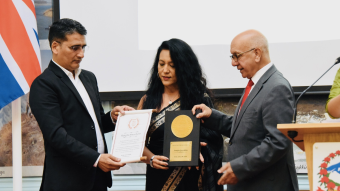
(This article is based on the speech by Dr Ghale, former President NRNA, at the event organized by Jaya Nepal International Foundation Global Youth Network on 14 February 2026 – Ed.)



सम्बन्धित सामग्रीहरू


हाम्रो सिफारिस



- १
- २
- ३
- ४
- ५